
When you begin learning a new language, one of the first and most important steps is understanding how people refer to themselves and others. In this guide to Italian language basics, we’ll explore the words Italians use for “I,” “we,” “you,” “you all,” and other key pronouns. These words are essential because they form the foundation of everyday conversation.
Italian pronouns help identify who is speaking, who is being spoken to, and who is being talked about. Therefore, once you understand how they work, you’ll find it much easier to form sentences, understand conversations, and communicate clearly in Italian.
This article will walk you through the most common Italian subject pronouns, how they’re used, when they’re often omitted, and how they connect to verb conjugations.
What Are Subject Pronouns?
In grammar, subject pronouns are the words that replace nouns as the subject of a sentence. In English, examples include:
- I
- you
- he
- she
- we
- they
Italian has a similar system, but there are some important differences that are key to mastering Italian language basics.
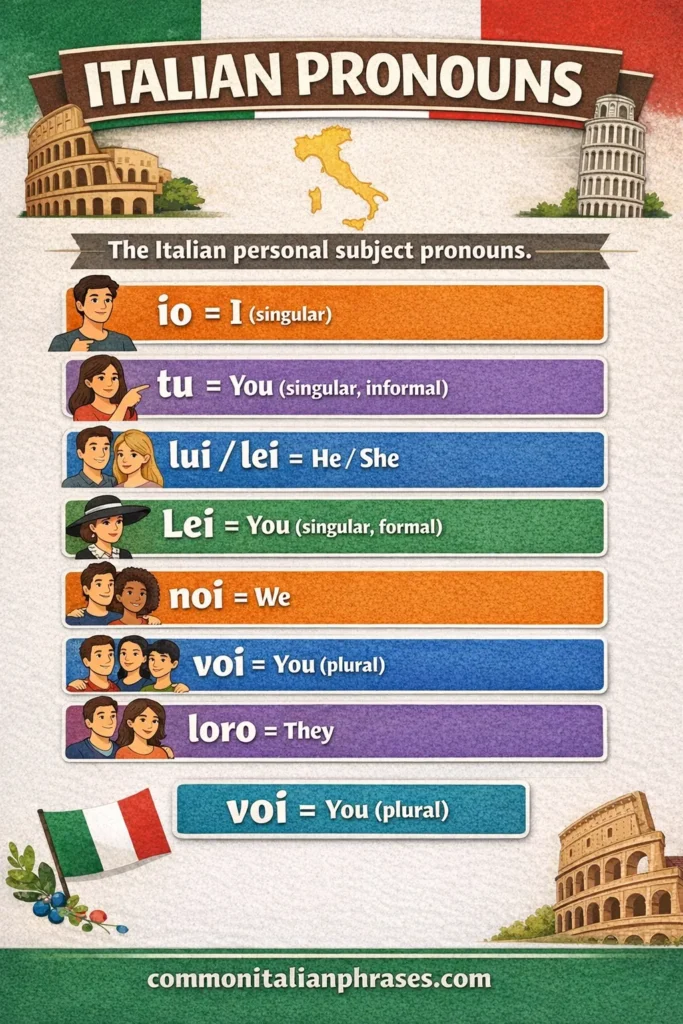
Here are the main Italian subject pronouns:
| English | Italian | Pronunciation |
|---|---|---|
| I | io | EE-oh |
| you (informal singular) | tu | too |
| he | lui | loo-ee |
| she | lei | lay-ee |
| you (formal singular) | Lei | lay-ee |
| we | noi | noy |
| you all / you plural | voi | voy |
| they (masculine or mixed) | loro | LOH-ro |
| they (feminine) | loro | LOH-ro |
Let’s explore how each of these works in real conversation.
“I” in Italian: Io
The Italian word for “I” is io.
Example sentences:
- Io mangio.
I eat. - Io studio italiano.
I study Italian.
However, one of the interesting features of the Italian language basics is that Italians often drop the subject pronoun entirely.
Instead of saying:
- Io mangio.
Most Italians simply say:
- Mangio.
Because the verb ending already tells us who the subject is.
In this case:
- mangio = I eat
The -o ending signals that the subject is I.
Pronouns like io are usually only included for emphasis or clarity.
For example:
- Io mangio, ma lui no.
I eat, but he doesn’t.
“You” (Singular Informal): Tu
The pronoun tu means “you” when speaking to one person informally.
This is used with:
- friends
- family
- children
- people your age
- people you know well
Examples:
- Tu lavori oggi?
Do you work today? - Tu parli italiano?
Do you speak Italian?
Just like with io, Italians often drop tu:
Instead of:
- Tu parli italiano?
They usually say:
- Parli italiano?
The -i ending on the verb already indicates you (tu).
Understanding this pattern is an important part of learning Italian language basics, because Italian sentences are often shorter than English ones.
“You” (Formal): Lei
Italian also has a formal way to say “you.” This is Lei (capitalized).
It’s used when speaking to:
- strangers
- older people
- professionals
- customers
- authority figures
Examples:
- Lei parla inglese?
Do you speak English? - Come si chiama Lei?
What is your name? (formal)
Even though Lei means “she” in other contexts, when used formally it means “you.”
This can be confusing for beginners, but context makes the meaning clear.
For example:
- Lei lavora qui?
Do you work here?
Again, in everyday speech the pronoun is often dropped:
- Lavora qui?
This is another key detail in Italian language basics.
“He” and “She”: Lui and Lei
The Italian pronouns for he and she are:
- lui = he
- lei = she
Examples:
- Lui mangia.
He eats. - Lei studia.
She studies.
As with other pronouns, Italians frequently omit them:
- Mangia.
He/She eats.
The verb ending -a tells us the subject is third-person singular.
Because of this, the pronoun is only used when:
- emphasizing the subject
- clarifying who is being discussed
- contrasting people
Example:
- Lui lavora, ma lei studia.
He works, but she studies.
“We”: Noi
The word for “we” in Italian is noi.
Examples:
- Noi mangiamo.
We eat. - Noi andiamo al ristorante.
We go to the restaurant.
But again, the pronoun is often dropped:
- Mangiamo.
Because -iamo clearly signals we.
Learning to recognize verb endings like this is also essential to mastering Italian language basics.
“You All”: Voi
Italian uses voi to refer to more than one person.
This is similar to:
- you all
- you guys
- you (plural)
Examples:
- Voi parlate italiano.
You all speak Italian. - Voi lavorate qui?
Do you all work here?
As usual, Italians frequently omit voi:
- Parlate italiano?
The verb ending -ate identifies the subject as you (plural).
“They”: Loro
The Italian pronoun for “they” is loro.
Examples:
- Loro mangiano.
They eat. - Loro studiano molto.
They study a lot.
Unlike other pronouns, loro is sometimes kept in sentences because verb endings can occasionally sound similar in speech.
Still, Italians often drop it:
- Mangiano.
They eat.
Why Italians Often Skip Pronouns
One of the most distinctive features of Italian language basics is that subject pronouns are also optional in many sentences.
This is because Italian verbs change form depending on the subject.
For example, with the verb parlare (to speak):
| Pronoun | Conjugation | Meaning |
|---|---|---|
| io | parlo | I speak |
| tu | parli | you speak |
| lui/lei | parla | he/she speaks |
| noi | parliamo | we speak |
| voi | parlate | you all speak |
| loro | parlano | they speak |
Because each ending is unique, Italians often skip the pronoun entirely.
Instead of saying:
- Io parlo italiano.
They simply say:
- Parlo italiano.
Understanding this concept is also one of the biggest steps in learning Italian language basics.
Further Examples of Pronouns in Everyday Conversations
Let’s also take a look at how these pronouns appear in natural conversations.
Meeting Someone
- Ciao! Come ti chiami?
Hi! What’s your name? - Mi chiamo Marco. E tu?
My name is Marco. And you?
Here we see tu used informally.
Speaking Formally
- Buongiorno. Lei parla inglese?
Good morning. Do you speak English? - Sì, parlo un po’.
Yes, I speak a little.
Talking About Others
- Lui lavora a Milano.
He works in Milan. - Noi viviamo a Roma.
We live in Rome.
Talking to a Group
- Voi studiate italiano?
Do you all study Italian? - Sì, studiamo ogni giorno.
Yes, we study every day.
Further Tips for Remembering Italian Pronouns
Here are a few helpful tips when studying Italian language basics.
1. Focus on Verb Endings
Because pronouns are often omitted, recognizing verb endings is crucial.
2. Practice Listening
Italian speakers frequently drop pronouns in conversation, so listening practice helps train your ear.
3. Use Pronouns for Emphasis
Pronouns are commonly used when:
- contrasting people
- clarifying subjects
- adding emphasis
Example:
- Io vado al cinema, tu resti a casa.
I go to the cinema, you stay home.
4. Learn Formal vs Informal Speech
Knowing when to use tu versus Lei is an important cultural aspect of Italian communication.
Why Pronouns Matter in Italian Language Basics
Subject pronouns might seem simple, but they are fundamental to understanding how Italian sentences work. They help you identify who is performing an action, and they connect directly to verb conjugations.
Mastering these pronouns will further help you to:
- understand spoken Italian more easily
- construct correct sentences
- recognize verb patterns
- communicate with further increased confidently with native speakers
Because Italian often omits pronouns, learning how verbs change with each subject will quickly improve your fluency.
Final Thoughts
Learning pronouns is one of the most important steps in understanding Italian language basics. Words such as io, tu, lei, noi, voi, and loro appear constantly in conversation, and they provide the structure for almost every sentence.
The key takeaway is that while Italian has clear equivalents for “I,” “we,” “you,” and “they,” these words are often left out of sentences because the verb endings already reveal the subject.
As you continue studying Italian, you also need to pay close attention to verb forms and how they connect to these pronouns. With practice, you’ll soon find that identifying subjects and forming sentences becomes much more natural.
Whether you’re traveling to Italy, studying the language for fun, or preparing for deeper language learning, mastering these pronouns will give you a strong foundation in Italian language basics.