
Learning common Italian phrases is one of the fastest ways to feel confident when speaking Italian. Whether you’re planning a trip to Italy, learning the language for fun, or simply want to communicate with Italian speakers, mastering a set of everyday expressions will make conversations much easier.
Italian is known for its musical sound, expressive gestures, and warm communication style. Even learning just a handful of common Italian phrases can help you navigate restaurants, ask for directions, greet locals, and also show appreciation for the culture.
In this guide, you’ll also discover over 100 common Italian phrases organized by real-life situations — greetings, travel, dining, shopping, emergencies, and more. By the end, you’ll have a strong foundation of everyday Italian expressions you can start using immediately and be able to converse confidently with Italians in their native tongue.
Why Learn Common Italian Phrases?
Before diving into the list, it’s helpful to understand why learning common Italian phrases is so useful.
Many travelers try to memorize complex grammar rules before speaking a new language. But focusing on practical phrases instead helps you communicate faster.
Benefits of learning common Italian phrases include:
- Easier communication while traveling
- Greater confidence speaking with locals
- Faster language learning progress
- A more authentic cultural experience
- Improved listening comprehension
Even if you only know basic Italian, locals appreciate the effort. Italians are generally warm and enthusiastic when visitors try to speak their language.
Now let’s explore the most useful common Italian phrases you’ll encounter in everyday conversations.
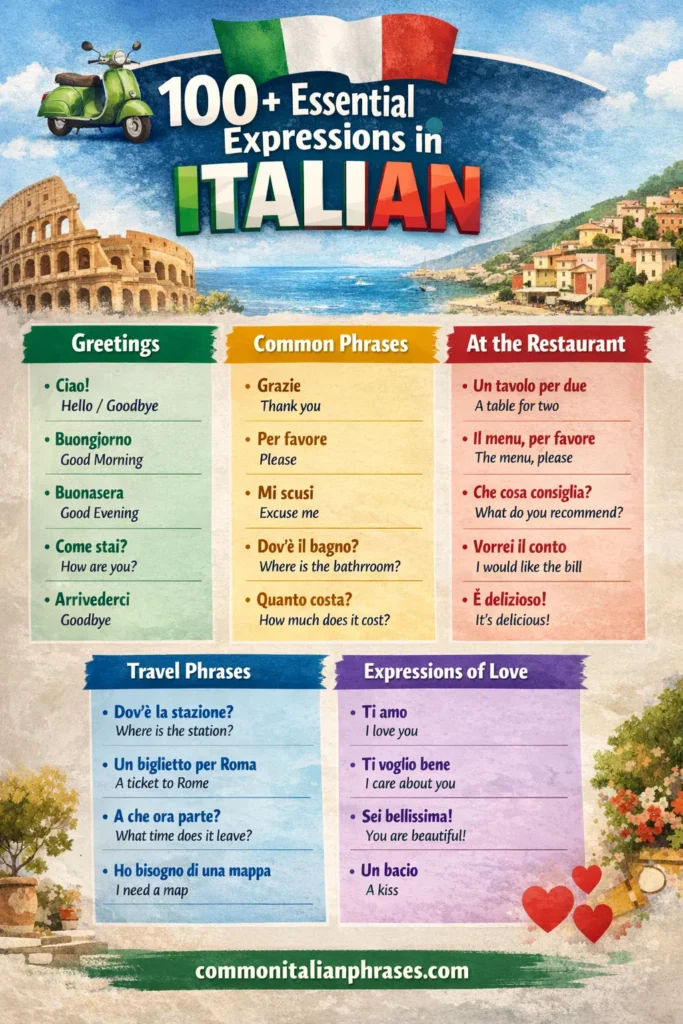
Basic Italian Greetings
Greetings are among the most important common Italian phrases to learn first.
Hello and Goodbye
- Ciao – Hello / Goodbye (informal)
- Salve – Hello (formal)
- Buongiorno – Good morning
- Buonasera – Good evening
- Arrivederci – Goodbye (formal)
- A presto – See you soon
- A dopo – See you later
Asking How Someone Is
- Come stai? – How are you? (informal)
- Come sta? – How are you? (formal)
- Tutto bene? – Everything good?
- Come va? – How’s it going?
Common Responses
- Sto bene – I’m well
- Molto bene – Very well
- Così così – So-so
- Non c’è male – Not bad
Learning these common Italian phrases helps you start conversations naturally.
Polite Italian Expressions
Politeness is very important in Italian culture, so knowing polite common Italian phrases will make a great impression.
Saying Please and Thank You
- Per favore – Please
- Per piacere – Please (alternative)
- Grazie – Thank you
- Grazie mille – Thank you very much
- Molte grazie – Many thanks
Responding to Thanks
- Prego – You’re welcome
- Di niente – It’s nothing
- Figurati – Don’t mention it (informal)
Apologizing
- Scusa – Sorry (informal)
- Scusi – Sorry (formal)
- Mi dispiace – I’m sorry
- Permesso – Excuse me (to pass through)
Using these common Italian phrases shows respect and friendliness.
Essential Italian Conversation Phrases
These common Italian phrases help keep everyday conversations flowing.
Basic Questions
- Come ti chiami? – What’s your name?
- Come si chiama? – What’s your name? (formal)
- Di dove sei? – Where are you from?
- Quanti anni hai? – How old are you?
- Cosa fai? – What do you do?
Useful Responses
- Mi chiamo… – My name is…
- Sono di… – I am from…
- Lavoro come… – I work as…
Understanding Conversations
- Capisco – I understand
- Non capisco – I don’t understand
- Può ripetere? – Can you repeat?
- Può parlare più lentamente? – Can you speak more slowly?
These common Italian phrases make communication much easier for beginners.
Common Italian Travel Phrases
Travelers can further benefit greatly from knowing these common Italian phrases.
Asking for Directions
- Dov’è il bagno? – Where is the bathroom?
- Dov’è la stazione? – Where is the station?
- Dov’è il centro? – Where is the city center?
- È lontano? – Is it far?
Transportation
- Un biglietto per favore – One ticket please
- Quanto costa? – How much does it cost?
- A che ora parte? – What time does it leave?
- A che ora arriva? – What time does it arrive?
Getting Help
- Puòi aiutarmi? – Can you help me?
- Ho bisogno di aiuto – I need help
- Sono perso – I am lost
These common Italian phrases can make navigating Italy much smoother.
Italian Restaurant and Food Phrases
Food is a huge part of Italian culture. Knowing these common Italian phrases will also enhance your dining experience.
Ordering Food
- Possiamo vedere il menu? – Can we see the menu?
- Vorrei… – I would like…
- Prendo questo – I’ll take this
- Cosa consiglia? – What do you recommend?
During the Meal
- È delizioso – It’s delicious
- Molto buono – Very good
- Complimenti allo chef – Compliments to the chef
Paying the Bill
- Il conto, per favore – The bill please
- Paghiamo separatamente? – Can we pay separately?
- Accettate carte di credito? – Do you accept credit cards?
Using these common Italian phrases helps you order confidently in restaurants.
Shopping Phrases in Italian
Shopping becomes much easier with these common Italian phrases.
Asking About Prices
- Quanto costa? – How much does it cost?
- È troppo caro – It’s too expensive
- Ha qualcosa di più economico? – Do you have something cheaper?
Trying Items
- Posso provarlo? – Can I try it on?
- Avete un’altra taglia? – Do you have another size?
- Avete un altro colore? – Do you have another color?
Buying Something
- Lo prendo – I’ll take it
- Va bene – That’s fine
- Accettate contanti? – Do you accept cash?
These common Italian phrases help avoid confusion while shopping.
Emergency Italian Phrases
In urgent situations, these phrases can be extremely important.
Asking for Help
- Aiuto! – Help!
- Chiami la polizia! – Call the police!
- Chiami un’ambulanza! – Call an ambulance!
Medical Needs
- Ho bisogno di un medico – I need a doctor
- Non mi sento bene – I don’t feel well
- Sono allergico a… – I am allergic to…
Reporting Problems
- Ho perso il portafoglio – I lost my wallet
- Ho perso il telefono – I lost my phone
- Mi hanno rubato… – Someone stole…
These common Italian phrases can be essential during emergencies.
Useful Italian Phrases for Everyday Situations
Here ere are some additional phrases you’ll often hear.
Agreeing and Disagreeing
- Sì – Yes
- No – No
- Forse – Maybe
- Certo – Of course
Expressing Opinions
- Penso di sì – I think so
- Non credo – I don’t think so
- Sono d’accordo – I agree
Showing Emotion
- Fantastico! – Fantastic!
- Incredibile! – Incredible!
- Che bello! – How beautiful!
These phrases add personality to conversations. Why niot try adding a little emotion when practicing them?
Tips for Learning Common Italian Phrases Faster
Memorizing these phrases doesn’t have to be difficult. With the right strategies, you can also learn quickly and retain more vocabulary.
Practice Daily
Spend at least 10–15 minutes each day reviewing new phrases. Consistent exposure helps your brain remember the language more effectively.
Use Flashcards
Flashcards are another powerful way to memorize these phrases. Apps like language learning tools can make practice fun and interactive. Such apps also include Duolingo and Lingopie.
Listen to Native Speakers
Listening to Italian podcasts, movies, or music helps you hear how phrases are actually pronounced.
Speak Whenever Possible
The best way to learn these phrases is also to use them in conversation. Therefore, you need to look for opportunities to engage with language exchange partners, tutors, or travel experiences can help.
Group Phrases by Situation
Learning phrases by situation — such as dining, travel, or greetings — makes them easier to remember.
Final Thoughts
Mastering these Italian phrases is one of the most effective ways to start speaking Italian quickly. Instead of focusing only on grammar, learning practical expressions allows you to communicate immediately.
Whether you’re ordering pasta at a restaurant, asking for directions in Rome, or greeting new friends, these phrases will help you navigate real conversations with confidence.
The key is consistent practice. Start by learning a few phrases each day. By following this path, you will also gradually expand your vocabulary. Therefore, over time, you’ll find yourself understanding more conversations and speaking with greater ease.
Language learning is a journey. Therefore, every new phrase you learn brings you one step closer to fluency.
So start practicing today — ciao e buona fortuna!
Learn Italian terms for the past, presnet and future tenses here.