
Learning a new language can feel overwhelming at first, but starting with Italian basic words and understanding how they work across past, present, and future tenses makes the journey much smoother. Italian is a beautifully expressive language, and mastering its structure begins with a strong grasp of everyday vocabulary and how it changes depending on time.
In this guide, we’ll explore common Italian words, essential verb forms, and practical Italian phrases to know so you can confidently communicate in real-life situations. Whether you’re just beginning or strengthening your foundation, this breakdown of Italian language basics will help you speak more naturally and clearly.
Why Tenses Matter in Italian Basics
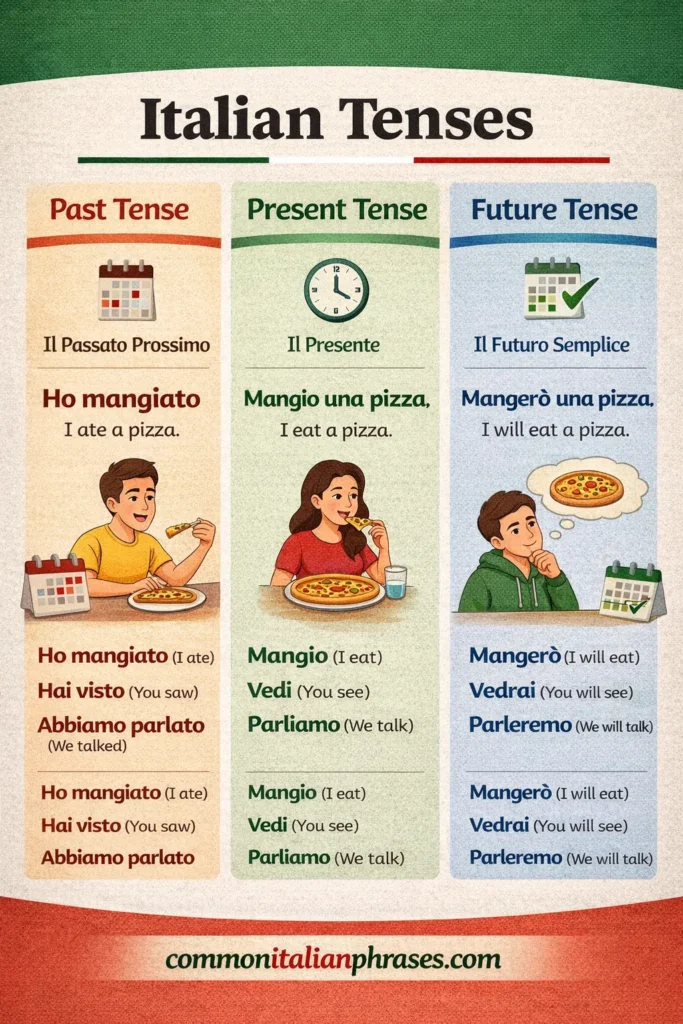
Before diving into vocabulary, it’s important to understand why tenses are essential. In Italian, verbs change depending on when an action happens—past, present, or future. This means that even simple phrases in Italian can look very different depending on the context.
For example:
- Present: Mangio (I eat)
- Past: Ho mangiato (I ate)
- Future: Mangerò (I will eat)
By learning key Italian phrases across all three tenses, you’ll be able to express yourself more accurately and sound more fluent.
Present Tense: Building Your Foundation
The present tense is the starting point for all learners. It’s used to describe what is happening now or what happens regularly.
Common Italian Words in the Present Tense
Here are some essential verbs and Italian basic words in their present form:
- Essere (to be) → sono (I am)
- Avere (to have) → ho (I have)
- Fare (to do/make) → faccio (I do)
- Dire (to say) → dico (I say)
- Andare (to go) → vado (I go)
- Vedere (to see) → vedo (I see)
These are part of the most common Italian words and are used constantly in everyday conversation.
Italian Phrases to Know (Present)
- Io lavoro oggi – I work today
- Lei parla italiano – She speaks Italian
- Noi mangiamo insieme – We eat together
- Loro vivono in Italia – They live in Italy
These simple phrases in Italian help you describe daily routines and habits.
Past Tense: Talking About What Has Happened
In Italian, one of the most commonly used past tenses is the passato prossimo. It’s used for completed actions.
Structure of the Past Tense
The passato prossimo is formed using:
- A helping verb (avere or essere)
- A past participle
Example:
- Ho visto – I saw
- Sono andato – I went
Common Italian Words in the Past Tense
Let’s look at some Italian basic words transformed into the past:
- Mangiare → ho mangiato (I ate)
- Bere → ho bevuto (I drank)
- Scrivere → ho scritto (I wrote)
- Venire → sono venuto (I came)
- Partire → sono partito (I left)
These verbs are essential in mastering Italian language basics.
Key Italian Phrases (Past)
- Ho studiato molto – I studied a lot
- Abbiamo viaggiato ieri – We traveled yesterday
- Sono arrivato tardi – I arrived late
- Hai capito? – Did you understand?
These key Italian phrases are incredibly useful for conversations about experiences and events.
Future Tense: Speaking About What Will Happen
The future tense in Italian is used to describe actions that will take place later. It’s straightforward once you learn the endings.
Structure of the Future Tense
For most verbs, you modify the infinitive and add endings:
- -ò (I)
- -ai (you)
- -à (he/she)
- -emo (we)
- -ete (you plural)
- -anno (they)
Example:
- Parlerò – I will speak
- Andremo – We will go
Italian Basic Words in the Future
Here are some important verbs in future form:
- Fare → farò (I will do)
- Avere → avrò (I will have)
- Essere → sarò (I will be)
- Vedere → vedrò (I will see)
- Dare → darò (I will give)
These are key elements of Italian basics that will expand your communication skills.
Italian Phrases to Know (Future)
- Domani lavorerò – Tomorrow I will work
- Viaggeremo presto – We will travel soon
- Studierai italiano – You will study Italian
- Sarà bello – It will be beautiful
These phrases in Italian help you express plans, intentions, and predictions.
Combining Tenses in Real Conversations
To truly master common Italian words, you need to see how tenses work together.
Example conversation:
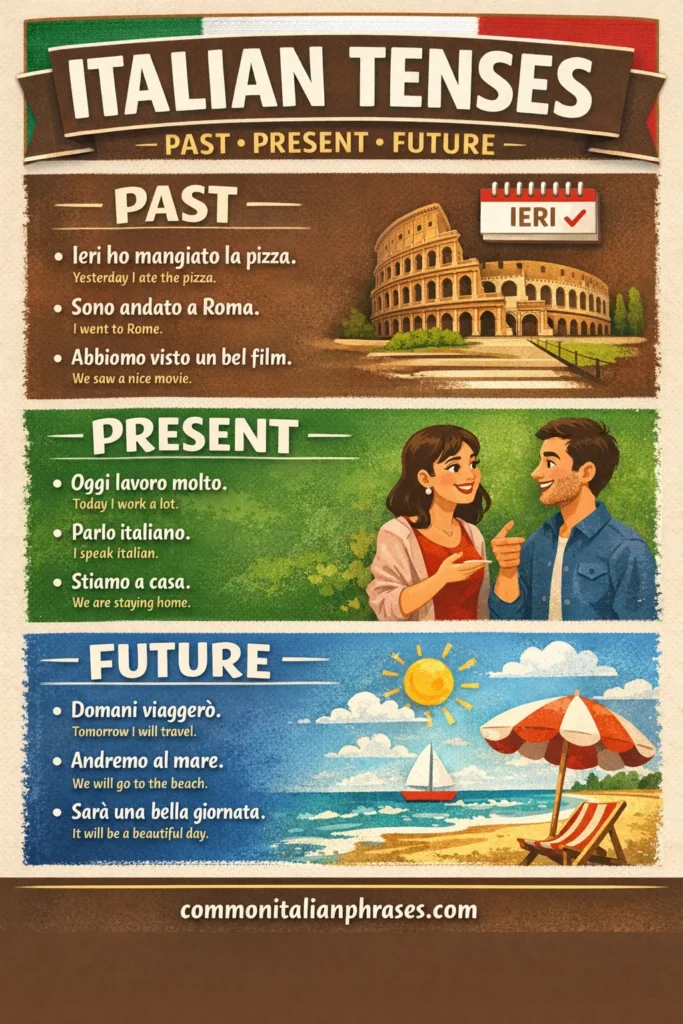
- Oggi studio italiano (Present – Today I study Italian)
- Ieri ho studiato italiano (Past – Yesterday I studied Italian)
- Domani studierò italiano (Future – Tomorrow I will study Italian)
This progression is a perfect example of how Italian basic words evolve across time.
Essential Time Expressions in Italian
Understanding time-related vocabulary is crucial when using tenses.
Present Time Words
- Oggi – Today
- Adesso – Now
- Sempre – Always
Past Time Words
- Ieri – Yesterday
- Prima – Before
- L’anno scorso – Last year
Future Time Words
- Domani – Tomorrow
- Presto – Soon
- Dopo – Later
These are foundational Italian phrases to know that help clarify meaning.
Tips for Learning Italian Language Basics Faster
1. Practice Daily
Consistency is key. Even 10 minutes a day reviewing Italian basic words can make a huge difference.
2. Use Real-Life Context
Try forming your own sentences using common Italian words in past, present, and future tenses.
3. Focus on High-Frequency Verbs
Verbs like essere, avere, and fare appear in countless phrases in Italian, so mastering them first gives you a strong advantage.
4. Listen and Repeat
Listening to native speakers helps reinforce pronunciation and natural usage of key Italian phrases.
Common Mistakes to Avoid
When learning Italian basics, beginners often make these mistakes:
- Mixing up essere and avere in the past tense
- Forgetting agreement with essere verbs
- Using the present tense instead of the future for plans
- Mispronouncing verb endings
Being aware of these helps you progress faster in mastering Italian language basics.
Practice Section: Try It Yourself
Translate these sentences using Italian basic words:
- I eat pizza today
- I ate pizza yesterday
- I will eat pizza tomorrow
Answers:
- Mangio pizza oggi
- Ho mangiato pizza ieri
- Mangerò pizza domani
This simple exercise shows how common Italian words change across tenses.
Expanding Your Vocabulary
Once you’re comfortable with tenses, start adding more Italian phrases to know:
- Mi piace – I like
- Non capisco – I don’t understand
- Quanto costa? – How much does it cost?
- Dove sei? – Where are you?
These key Italian phrases will make everyday interactions much easier.
Final Thoughts
Mastering Italian basic words across past, present, and future tenses is one of the most important steps in learning the language. By focusing on common Italian words, practicing essential verbs, and using practical phrases in Italian, you’ll quickly build confidence in your speaking and comprehension skills.
Remember, language learning is a gradual process. Start with the essentials, practice consistently, and don’t be afraid to make mistakes. Over time, these Italian language basics will become second nature, allowing you to communicate naturally and effectively.
Whether you’re traveling, studying, or simply passionate about languages, building a solid foundation with Italian basics will open the door to deeper understanding and richer conversations.