
If you’re learning Italian, you’ve probably wondered how to translate English “-ing” words like doing, eating, or going. These action words are everywhere in English—but Italian works a little differently. To truly understand common Italian words, especially action words, you need to learn how Italian expresses the idea of “-ing.”
In this complete guide, we’ll break down how “-ing” forms work in Italian, explore essential verbs, and give you real-life Italian phrases to know so you can speak naturally and confidently. Whether you’re new or building your skills, this guide covers the most important Italian language basics related to action words.
Do “-ING” Words Exist in Italian?
Unlike English, Italian doesn’t have a direct equivalent for all “-ing” words. Instead, it uses a form called the gerundio (gerund), which is one of the most important structures in Italian basics.
The gerund expresses actions like:
- Doing
- Eating
- Speaking
But it’s used differently than in English.
Forming the Italian “-ING” (Gerund)
To form “-ing” verbs in Italian, you change the ending of the verb:
- -are → -ando
- -ere → -endo
- -ire → -endo
Examples of Common Italian Words
- Fare → facendo (doing)
- Mangiare → mangiando (eating)
- Leggere → leggendo (reading)
- Dormire → dormendo (sleeping)
These are essential common Italian words that help you describe actions in progress.
Italian Phrases to Know Using “-ING”
Let’s look at how these forms appear in real phrases in Italian.
Using “Stare” + Gerund (Present Continuous)
The most common way to say “I am doing” something is:
Stare + gerund
Examples:
- Sto mangiando – I am eating
- Sta parlando – He/She is speaking
- Stiamo lavorando – We are working
These are key Italian phrases to know for everyday conversation.
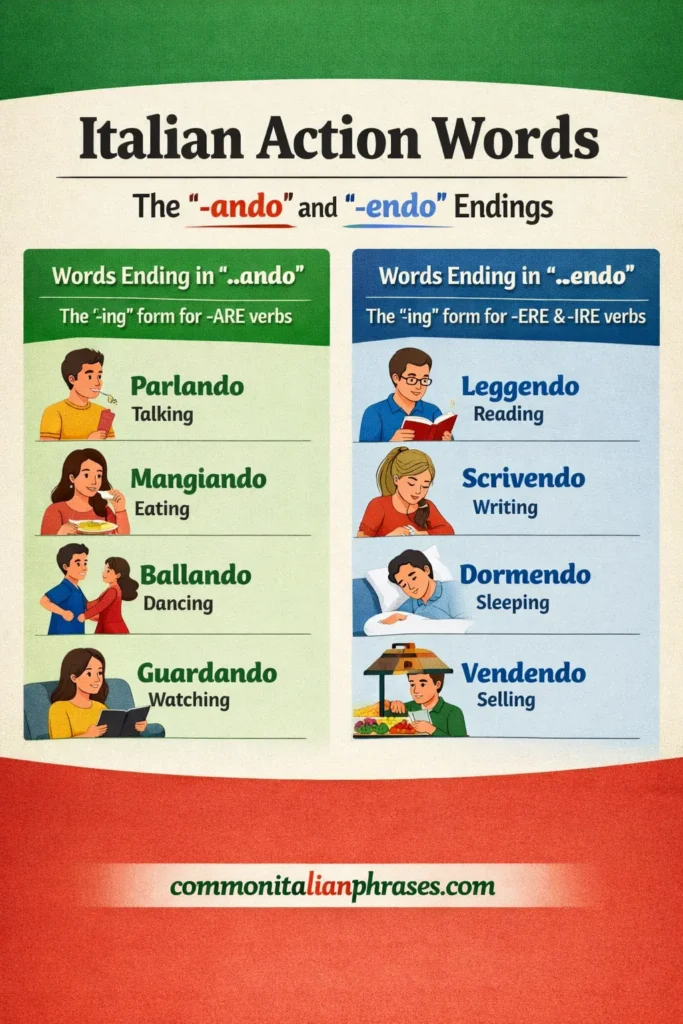
Common Italian Words for Daily Actions (-ING Forms)
Here are some essential verbs in their “-ing” form:
Everyday Activities
- Camminare → camminando (walking)
- Correre → correndo (running)
- Scrivere → scrivendo (writing)
- Guardare → guardando (watching)
- Ascoltare → ascoltando (listening)
Example:
- Sto ascoltando musica – I am listening to music
These are practical key Italian phrases you’ll use often.
Using “-ING” Without “Stare”
In Italian, the gerund can also be used alone, without stare. This is an important part of Italian language basics.
Example:
- Camminando per la strada, vedo un amico
– Walking down the street, I see a friend - Studiando molto, impari velocemente
– By studying a lot, you learn quickly
These types of phrases in Italian are slightly more advanced but very useful.
Expressing “While Doing Something”
The gerund is often used to say “while doing something.”
Examples:
- Mangio guardando la TV
– I eat while watching TV - Parla guidando
– He speaks while driving
These are natural Italian phrases to know for describing simultaneous actions.
Important Differences from English
When learning common Italian words, it’s important to understand that Italian doesn’t always use “-ing” like English.
English vs Italian
- “I like swimming”
→ Mi piace nuotare (NOT nuotando) - “Reading is fun”
→ Leggere è divertente
In these cases, Italian uses the infinitive, not the gerund. This is a key concept in Italian basics.
Reflexive Verbs in “-ING” Form
Reflexive verbs also have gerund forms.
Examples:
- Lavarsi → lavandosi (washing oneself)
- Vestirsi → vestendosi (getting dressed)
Example sentence:
- Si prepara vestendosi velocemente
– He/She gets ready by dressing quickly
These are useful phrases in Italian for daily routines.
Common Italian Words for Travel and Movement
These verbs are especially helpful in real-life situations:
- Andare → andando (going)
- Venire → venendo (coming)
- Partire → partendo (leaving)
- Arrivare → arrivando (arriving)
Examples:
- Sto andando al lavoro – I am going to work
- Sta arrivando ora – He/She is arriving now
These are essential key Italian phrases for travel.
Using “-ING” in Conversations
Here’s how you might use gerunds in real dialogue:
- Cosa stai facendo?
– What are you doing? - Sto studiando italiano
– I am studying Italian - Stiamo cenando
– We are having dinner
These are some of the most common Italian phrases to know.
Expanding Your Vocabulary with “-ING” Words
Here are more common Italian words in gerund form:
- Aprire → aprendo (opening)
- Chiudere → chiudendo (closing)
- Comprare → comprando (buying)
- Vendere → vendendo (selling)
Try using them in your own phrases in Italian.
Tips for Mastering Italian “-ING” Forms
1. Learn Patterns First
Focus on endings (-ando, -endo) to quickly recognize common Italian words.
2. Practice with “Stare”
Start with simple Italian phrases to know like sto mangiando.
3. Compare with English
Notice when Italian uses the infinitive instead of “-ing.”
4. Use Real-Life Context
Create your own key Italian phrases based on daily activities.
Common Mistakes to Avoid
When learning Italian language basics, avoid:
- Using gerund instead of infinitive
- Forgetting to use stare for continuous actions
- Mixing up verb endings
- Overusing “-ing” translations
Understanding these differences will improve your fluency.
Practice Section
Translate these into Italian:
- I am eating
- She is reading
- We are going to the city
Answers:
- Sto mangiando
- Sta leggendo
- Stiamo andando in città
These exercises help reinforce Italian basics.
Building Confidence with Italian Phrases to Know
The more you practice, the easier it becomes to use gerunds naturally. Start with simple common Italian words, then build longer sentences.
Example:
- Sto scrivendo un messaggio – I am writing a message
- Sto imparando italiano – I am learning Italian
These are powerful phrases in Italian that make you sound more fluent.
Final Thoughts
Understanding how Italian expresses “-ing” forms is essential for mastering common Italian words and building natural sentences. While Italian doesn’t use “-ing” in exactly the same way as English, the gerund provides a clear and flexible way to describe actions in progress.
By learning these patterns, practicing real-life Italian phrases to know, and applying them in conversation, you’ll quickly improve your fluency and confidence.
Stick with the basics, practice regularly, and soon these Italian language basics will feel completely natural. With time, you’ll be able to express yourself clearly using a wide range of key Italian phrases and everyday action words.
Learn the different Italian words for the pronouns.